
DESIGN / CONSTRUCTION / WATER QUALITY
DESIGN / CONSTRUCTION / WATER QUALITY
Building a Swimming Pool: Seven Decisions That Determine Its Long

-Term Success
A beautifully designed swimming pool can transform a home. But what distinguishes a pool that looks wonderful on completion from one that continues to perform exceptionally well for decades?
At Waterbrook Pools, we believe the answer lies as much in engineering and construction as it does in appearance.
A swimming pool is a complex structure that must safely contain thousands of litres of water, withstand environmental and structural forces, and operate efficiently through carefully coordinated mechanical and electrical systems.
Whether planning a contemporary outdoor pool, an elegant indoor swimming environment or a bespoke pool integrated into a new home, there are several fundamental decisions worth making before construction begins.
Here are seven of the most important
1. Start with the site, not the swimming pool
It is tempting to begin the design process by choosing the shape, dimensions and colour of a swimming pool. However, the most successful projects begin with a detailed understanding of the site.
Ground conditions, groundwater levels, drainage, proximity to existing buildings, site access, orientation and changes in level can all significantly influence the design and construction method.
A swimming pool must resist the pressure exerted by the water it contains. Depending on its construction and location, it must also resist external soil pressures and potentially groundwater uplift.
This is particularly important where pools are constructed on sloping sites, near retaining walls or within restricted residential plots. In coastal locations such as Devon and Cornwall, access restrictions, challenging topography and site-specific ground conditions can add further complexity.
Our approach: Understand the site constraints early, undertake appropriate investigations and involve the relevant engineering specialists before committing to a particular construction method.
2. Choose the right pool construction system
Swimming pool construction has evolved considerably. Traditional reinforced-concrete swimming pools remain an excellent option, particularly where complex structural arrangements, unusual geometry or particular architectural finishes are required.
However, advances in factory manufacturing have also opened up exciting alternatives.
One-piece swimming pool shells can offer significant advantages in construction efficiency, consistency of manufacture and installation time, provided that the site and design are suitable.
At Waterbrook, we are particularly interested in the bespoke polypropylene pools manufactured by Belgian specialist Carropools.
These pools offer considerable freedom in shape, dimensions and features, while benefiting from factory-controlled manufacturing and quality inspections.
The shells are manufactured using solid-colour polypropylene copolymer, a material selected for its durability and suitability for swimming pool construction.

Nevertheless, even the finest factory-manufactured shell requires professional site preparation, carefully designed foundations and supporting works, correctly coordinated pipework, and an installation methodology appropriate to the site.
Delivery vehicle access, lifting operations and the available working area must also be considered.
There is no universally perfect pool construction method. The correct choice is the one that best suits the client’s requirements, site constraints and long-term expectations.Nevertheless, even the finest factory-manufactured shell requires professional site preparation, carefully designed foundations and supporting works, correctly coordinated pipework, and an installation methodology appropriate to the site.
Delivery vehicle access, lifting operations and the available working area must also be considered.
There is no universally perfect pool construction method. The correct choice is the one that best suits the client’s requirements, site constraints and long-term expectations.
3. Treat water quality as an engineering discipline
The appearance of pool water tells only part of the story. Clear water is desirable, but visual clarity alone does not demonstrate that water is hygienically safe.
Effective pool water management depends upon several related processes, including circulation, filtration, treatment, monitoring and routine maintenance.
For many years, conventional chlorine-based systems have been the standard solution for domestic swimming pools. These remain an established option when properly designed, operated and maintained.
However, technological developments are introducing alternative approaches to water treatment.
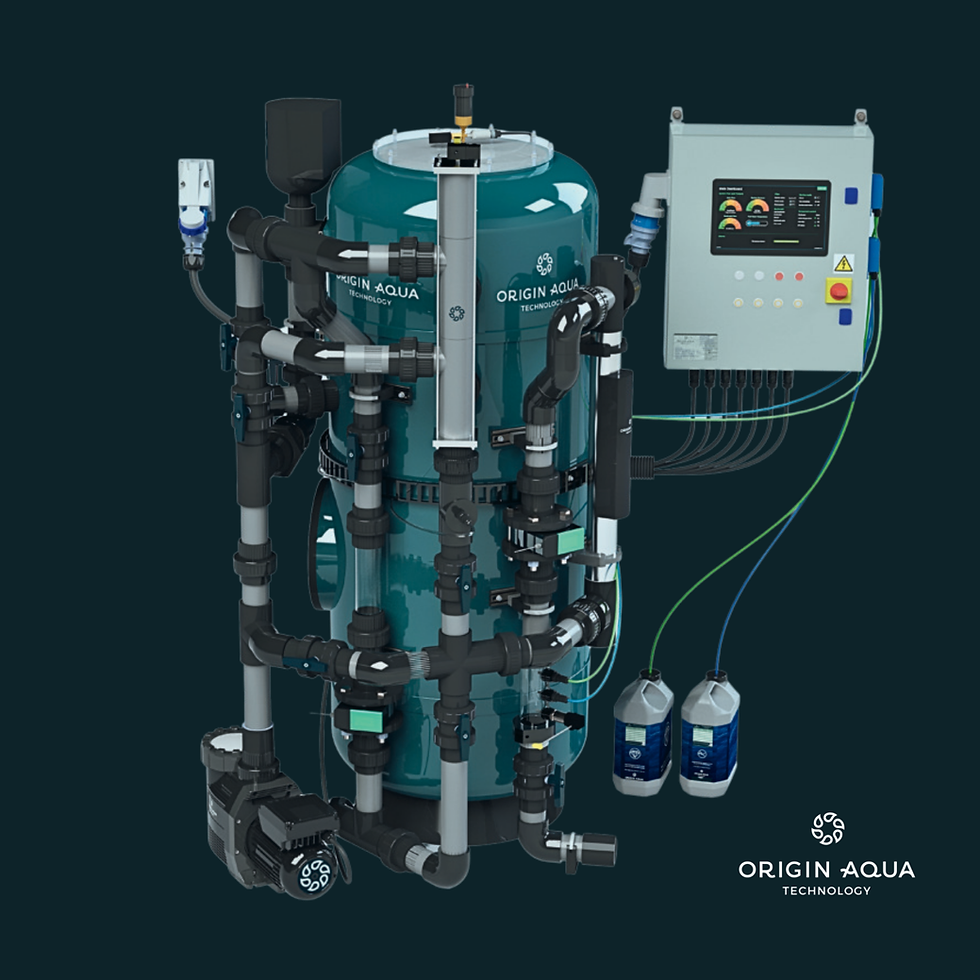
One such innovation is the Origin Aqua Mineral+Biome® system, which uses fine filtration, beneficial biological processes, ultraviolet treatment and mineral conditioning as part of its approach to chlorine-free pool water.
This technology is of particular interest to Waterbrook because it represents an opportunity to consider water quality from a different engineering perspective.
Any proposed treatment system must, however, be assessed against the intended pool use, appropriate water-quality criteria, monitoring requirements and the manufacturer’s validated operating conditions.
Water circulation is equally important. Poorly positioned inlets and outlets, inadequate hydraulic design or insufficient filtration capacity can undermine even sophisticated treatment equipment.
Our approach: Select the water-treatment strategy at the design stage, and engineer the complete circulation and filtration system around it.
4. Design the heating system and pool cover together
One of the most important considerations for any heated swimming pool is energy consumption.
A swimming pool continuously exchanges heat with its surroundings. In an uncovered outdoor pool, evaporation can be a major source of heat loss, alongside convection, radiation and other losses.
This means that even a highly efficient heating system may be expensive to operate if unnecessary heat loss is not properly controlled.
A correctly specified pool cover can make a substantial difference by reducing evaporation and associated heat demand.
The design should therefore consider the pool cover, heating system, insulation, expected water temperature and intended swimming season together.
Air-source heat pumps are increasingly used for swimming pool heating, but their actual efficiency depends upon operating conditions, water temperature and system design.
For a new project, it is sensible to assess expected running costs before finalising the specification.
In our view, genuine sustainability means examining the lifetime performance of the entire installation rather than concentrating solely on the efficiency rating of an individual component.
5. For indoor pools, engineer the building as carefully as the pool
Indoor swimming pools introduce another layer of technical complexity.
Warm water evaporates into the surrounding air, creating a humid internal environment. Without appropriate environmental control, moisture can condense on colder surfaces and contribute to deterioration of finishes, insulation, structural elements and mechanical components.
Where chlorinated water is used, air quality and the possible effects of chloramines and corrosive conditions must also be considered.
Successful indoor pool environments require carefully coordinated design of the building fabric, insulation, vapour control, ventilation, dehumidification, heating and air movement.

An architecturally integrated indoor pool illustrates why pool and building-services design must be considered together.
These systems must work together. An indoor pool should never simply be viewed as a swimming pool with a building constructed around it.
Instead, the pool and its enclosure should be designed as one integrated environment, ideally with the architect, structural engineer, pool specialist and building-services designer collaborating from the outset.
6. Think about maintenance before construction begins
A well-designed swimming pool should be straightforward to operate and service.
Unfortunately, plant rooms and maintenance access are sometimes treated as secondary considerations, particularly where space is limited.
A pool plant room must accommodate filtration equipment, pumps, valves, controls, heating connections and the components required by the selected water-treatment system.
It must also provide safe access for maintenance, inspection and future replacement of equipment.
Poorly arranged pipework, inaccessible valves or inadequate working space can turn otherwise simple servicing tasks into expensive and frustrating exercises.
Modern control and monitoring systems may offer the additional benefit of remote monitoring and fault notifications. However, automation is no substitute for correct design and appropriate inspection and servicing.
Our approach: A successful plant room is not necessarily the one with the most equipment. It is the one where every component has been properly selected, coordinated, installed and made accessible.
7. Insist on proper testing, commissioning and handover
The quality of a swimming pool cannot be judged solely by its appearance on the day it is finished.
Before handover, its structure, mechanical systems, water circulation, treatment equipment, electrical installations and safety features must be appropriately inspected and tested.
Depending on the construction system, this may include pressure testing of pipework, inspections of waterproofing or shell installations, verification of circulation and treatment performance, and commissioning of heating and control systems.
Clients should also receive clear instructions explaining how their pool operates and what maintenance is necessary.
Proper handover documentation should include relevant product information, operating instructions, warranties, as-built records and commissioning information.
These records are valuable throughout the life of the swimming pool, particularly when servicing equipment or carrying out alterations many years later.
At Waterbrook, we believe that documented quality control and proper handover procedures should be fundamental parts of professional pool construction.
The Waterbrook philosophy: Beauty supported by engineering
A remarkable swimming pool should combine elegant design, exceptional craftsmanship and reliable technical performance.
Achieving that balance requires more than selecting attractive finishes or expensive equipment.
It involves asking the right questions early, coordinating the different design disciplines, choosing appropriate materials and technologies, and maintaining rigorous standards throughout construction.
Our background in high-end residential building and project management informs every aspect of this approach.
We are also continually exploring technologies and construction methods that may offer genuine improvements in water quality, installation efficiency, durability and environmental performance.
Ultimately, our ambition is simple: to create exceptional indoor and outdoor swimming pools that clients will be proud to own and enjoy for decades.
Comments